
Wheat Drying Machine: Temperature Limits and Airflow
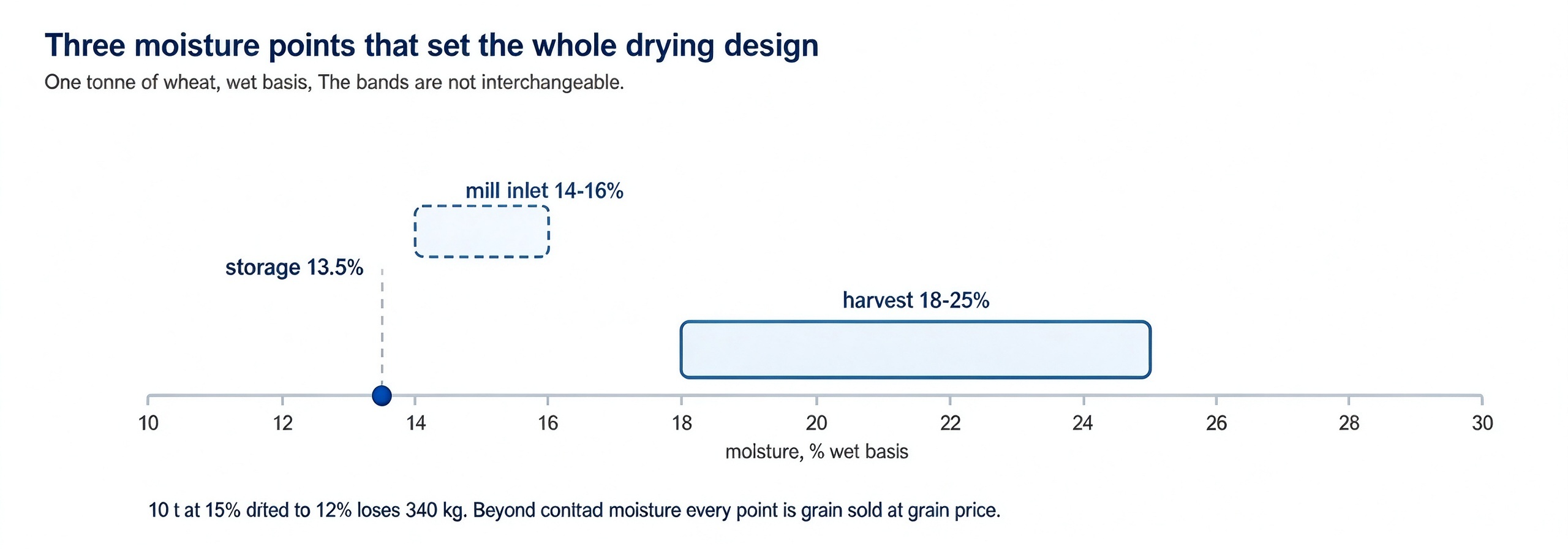
A wheat drying machine is sized from three moisture figures, not from tonnage: 18 to 25% wet basis at harvest, 13.5% equilibrium for safe storage, and 14 to 16% at the mill inlet after conditioning. Set those three numbers in the right order and most selection errors are removed before a quotation is written.
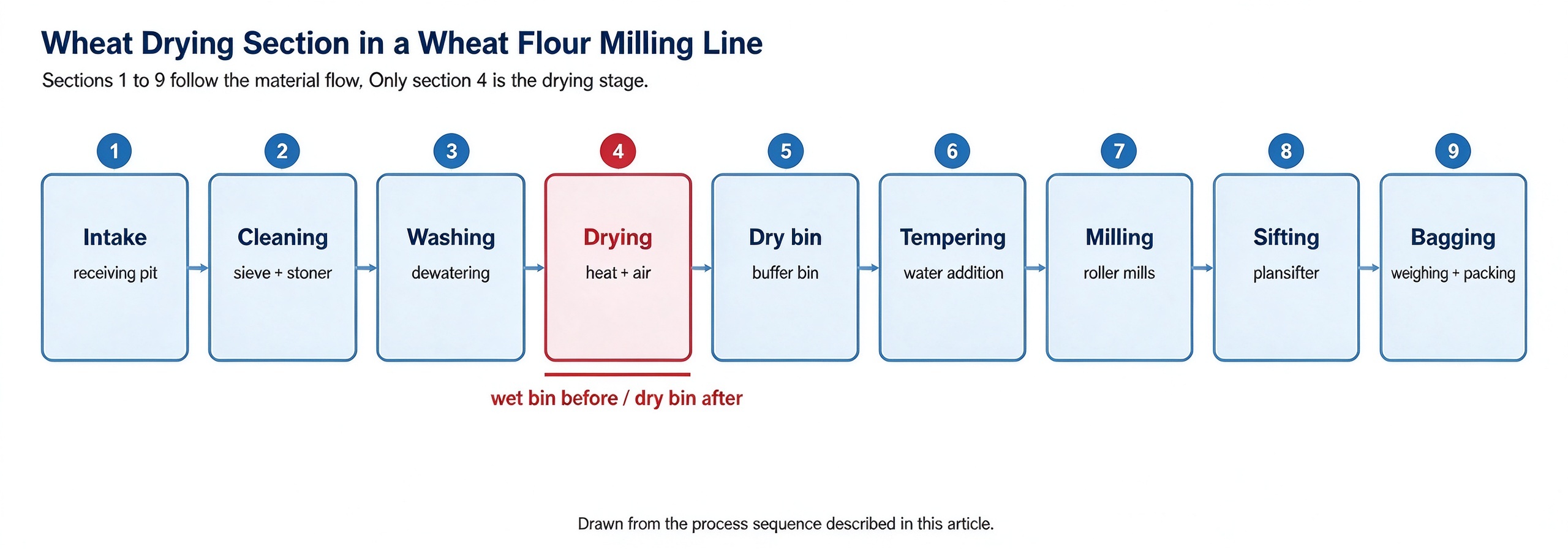
This article follows the drying section through a wheat flour production line: where it sits between grain cleaning and tempering, which dryer type suits which line capacity, which temperature and airflow limits protect milling quality, and what the section adds to the plant in footprint, connected power and dust control. Figures are taken from FAO post-harvest guidance and peer-reviewed drying studies, and the basis is stated at each point.
Wheat Drying in the Flour Milling Process
Drying touches a wheat line at one end only: intake. Grain arrives wet, is cleaned, is dried if the moisture band requires it, and then has water added back before milling. The wheat drying machine is therefore a short section between the cleaning house and the tempering bins, and every decision about it is taken against those two neighbours rather than in isolation.
Three Wheat Moisture Targets: Harvest, Storage and Milling
Drying appears at two points in a wheat chain: after harvest, to bring grain below the storage threshold, and at the mill intake, as a correction for wet deliveries. FAO puts normal harvest moisture at 18 to 25% wet basis. At 27 °C and 70% relative humidity, wheat comes to equilibrium at 13.5% (FAO, Crop handling, conditioning and storage, Table 9.1). Above that figure, respiration, mould and sprouting take over, and a hot spot spreads by convection once it starts. Seed grain is held one to two points drier than grain for human consumption, so a mill storing both needs two moisture targets rather than one.
Where a Wheat Dryer Sits in the Milling Line
-
The sequence around the dryer is fixed, and each element decides something about the unit that will be bought.
-
Grain is tipped into a receiving pit and lifted to the cleaning house, where a vibrating separator, a gravity stoner and a rotary screen remove large impurities, stones and fines. Wheat that is washed passes a dewatering screen or centrifuge before it reaches the dryer, so the dryer never handles free surface water.
-
Dried grain drops into a dry bin sized for one shift or one day of milling, and from there the tempering stage adds water back to milling moisture. Conveying between these points is by bucket elevator or by pneumatic grain conveyors, and the choice affects both the layout and the dust load on the dryer.
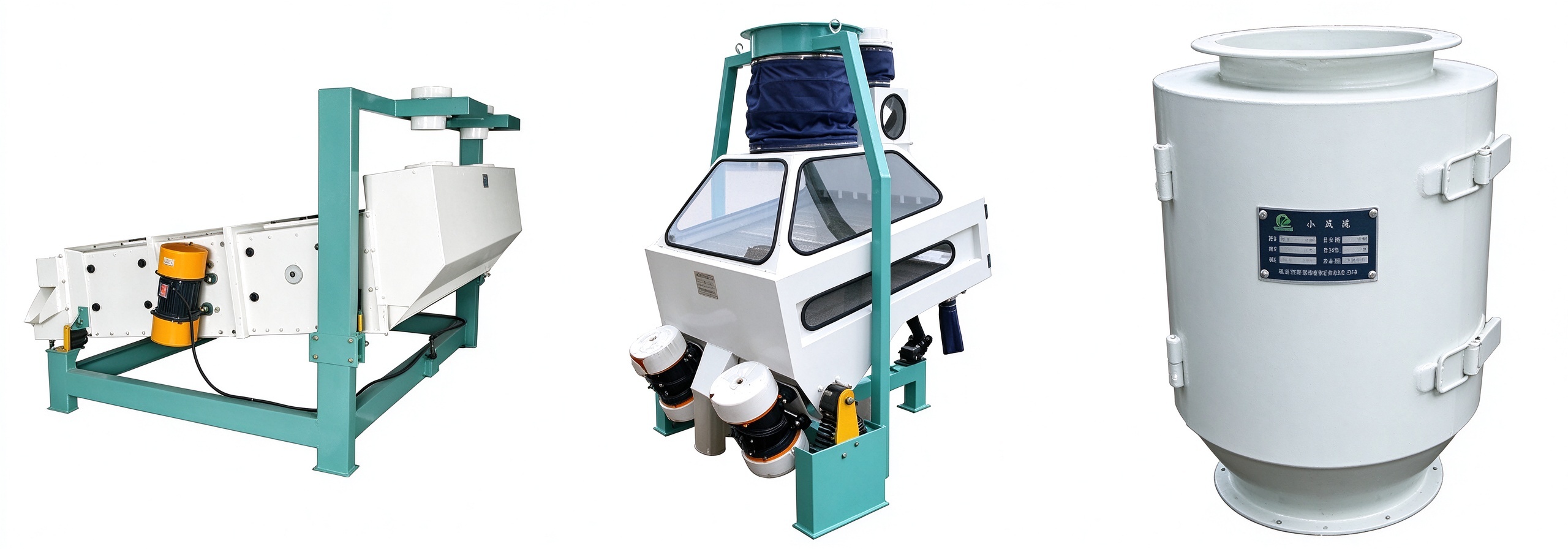
Sifter, gravity destoner and magnetic selector.
Two capacities therefore have to be quoted together: the dryer's own throughput and the buffer volume on each side of it. A dryer matched to the mill but without a wet bin upstream will be stopped every time a truck arrives late, and a dryer without a dry bin downstream forces the mill to run at the dryer's pace rather than at its own.
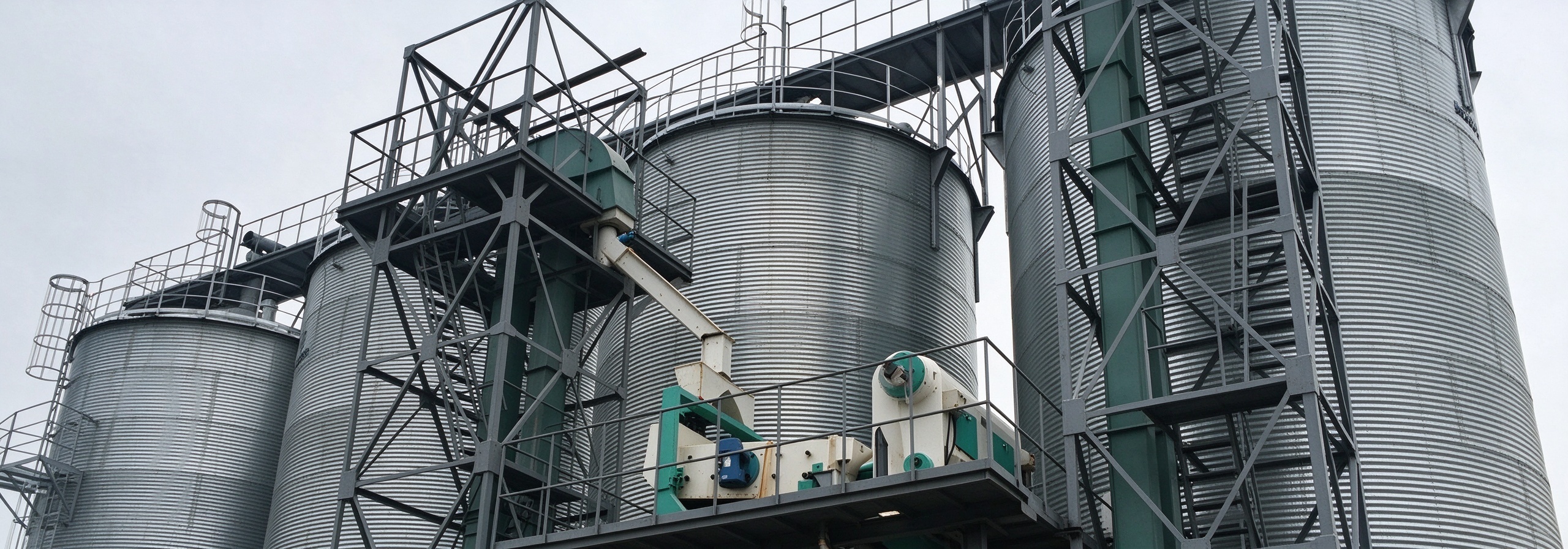
Silos and elevator either side of the drying section.
When a Grain Dryer Is Not Required
Below the storage threshold the mill changes direction. Cleaning removes surface dirt and light impurities, washing is followed by dewatering rather than drying, and grain conditioning adds water to reach milling moisture instead of removing it. A wet harvest is the only routine case that calls for a dryer, and a site that already buys wheat at 12.5 to 13.5% does not need one at all. Details of the upstream stage are set out under grain cleaning equipment, and the intake check for delivered lots under how to choose high quality wheat.
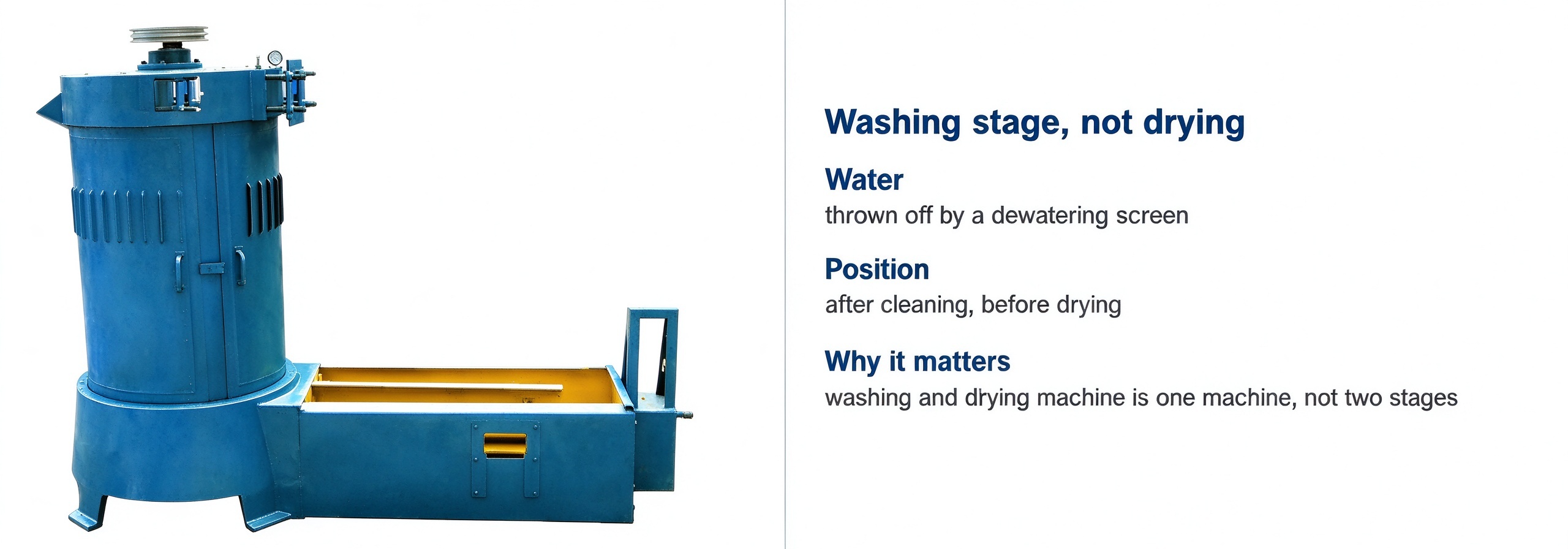
Washing stage: water thrown off, not evaporated.
Moisture Content After Drying: the Mill Adds Water Back
-
Wheat moisture content before milling is a different target from storage moisture, and the mill spends most of its water control adding rather than removing.
-
Published work on the conditioning of wheat brings grain to 14 to 16% before milling (Kweon and Martin), with hard wheat held at the upper part of that band and a rest time measured in hours rather than minutes.
-
Hard and soft wheat sit in different parts of that band, and the flour types those percentages serve are set out under types of wheat flour.
The terminology in buyer enquiries goes wrong at this point. A wheat washing and drying machine, as the phrase appears in search data, usually means a washer followed by a dewatering screen or centrifuge, not a hot-air dryer; the water is thrown off, not evaporated. The same confusion sits behind searches for "do large mills wash and dry wheat grains", where the expected answer is a dryer and the actual one is a dewatering screen. Our own KS-E moisture control system handles the tempering step and logs the added water per batch, which is the figure an extraction claim is later checked against. The wider sequence is set out under how a flour mill production process works, and the auxiliary equipment around this stage under flour milling process auxiliary machines.
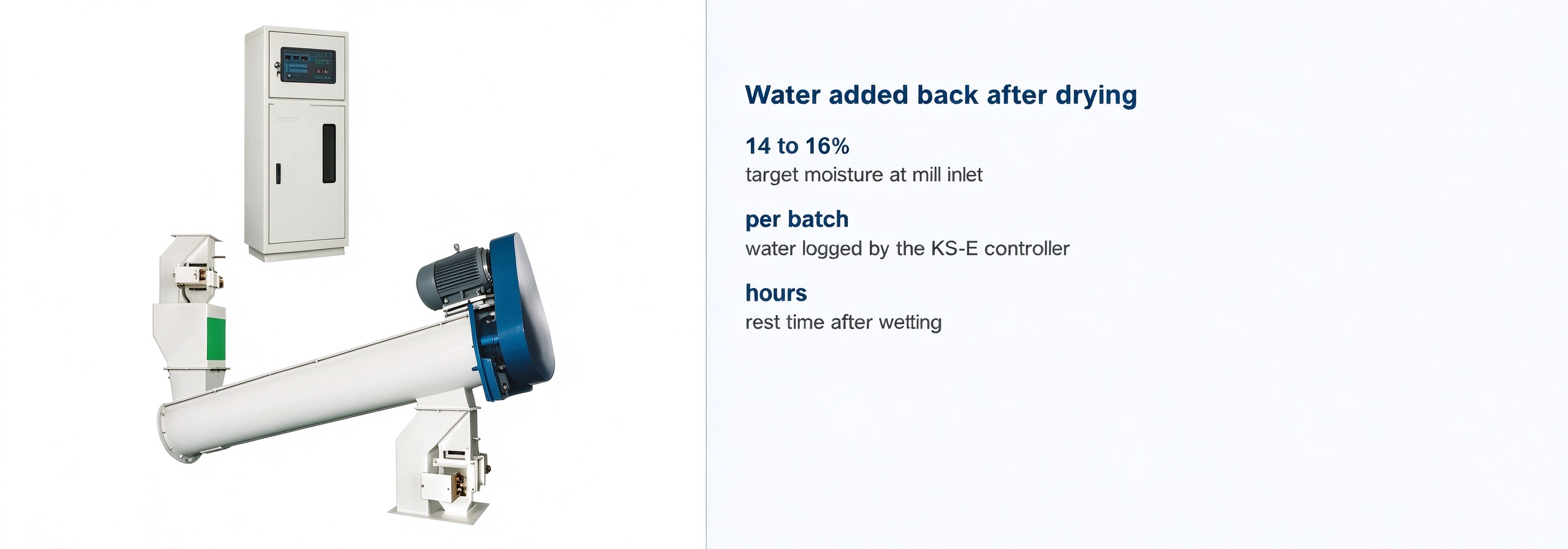
Water added back before milling, metered by KS-E.
Wheat Drying Machine Types, Capacity and Operating Limits
A wheat drying machine is selected on batch size and on the grain temperature rise a buyer is willing to accept, not by the tonnage on a nameplate. Four wheat dryer types cover the range from a 2 t batch to a continuous grain drying tower, and each one carries a limit that decides whether it fits the line it will be bolted onto.
Four Wheat Dryer Types at a Glance
| Dryer type | Grain depth | Heat input | Where it fits | Practical limit |
|---|---|---|---|---|
| Continuous-flow (tower grain dryer) | Grain sheet 100 to 150 mm | High air temperature | Large intake, steady feed, one or two varieties | Must end in an ambient cooling section, or the grain re-wets in the bin |
| Recirculating batch | Full batch in one chamber | Moderate | Small to medium output, several varieties, frequent grade changes | Higher energy per tonne; needs a rest period between passes |
| Flat-bed deep layer | 0.3 to 3.5 m | Unheated air or less than 6 °C rise | Low-temperature drying, seed and food wheat on one site | Static pressure climbs with depth; airspeed held at 0.10 to 0.15 m/s |
| Sack-stack | Two to three sack layers | 6 to 14 °C above ambient | Very small lots, bagged handling, rental premises | Moisture falls only about 0.5 percentage point per hour |
The Fifth Option: a Fluidised-Bed Grain Dryer
The depth and heat figures follow FAO guidance for continuous-flow, deep-layer and sack drying. A fifth option appears in some quotations: a fluidised-bed unit offered as a wheat drying machine for high-moisture lots. It dries fast and is worth pricing when intake peaks above 20%, but the same thin-layer, high-velocity logic makes dust control the deciding cost item rather than the dryer body.
Wheat Drying Temperature: the 60 °C Grain Ceiling
-
The best temperature for drying wheat for milling is a grain temperature, not an air temperature, and 60 °C is the ceiling most often quoted for food wheat in drying studies; seed wheat is held lower. Moisture is then reduced in stages, two to three percentage points per pass followed by a rest period, rather than one pull straight to target.
-
The reason is mechanical. Overdrying and excessive temperature set up stresses inside the kernel, which shows up as cracking and as loss of viability (FAO). Cracked grain breaks into fine particles on the first break, those particles load the sifter and the purifier, and extraction falls without any machine having failed. Overdrying also has a direct commercial cost: 10 tonnes of wheat at 15% weighs 340 kg less at 12%, so every point removed beyond the contract moisture is weight sold at the price of grain.
Two-stage operation recovers part of the loss. In a 2025 study of hybrid tempering and hot-air drying, tempering before drying shortened total drying time and shifted flour pasting properties, and the authors concluded that moderate initial moisture with an extended tempering stage gave the better flour quality. For a mill that already owns conditioning bins, that result argues for drying to a holding moisture and finishing after a rest, rather than drying in one pass.
Airflow and Static Pressure for a Grain Dryer
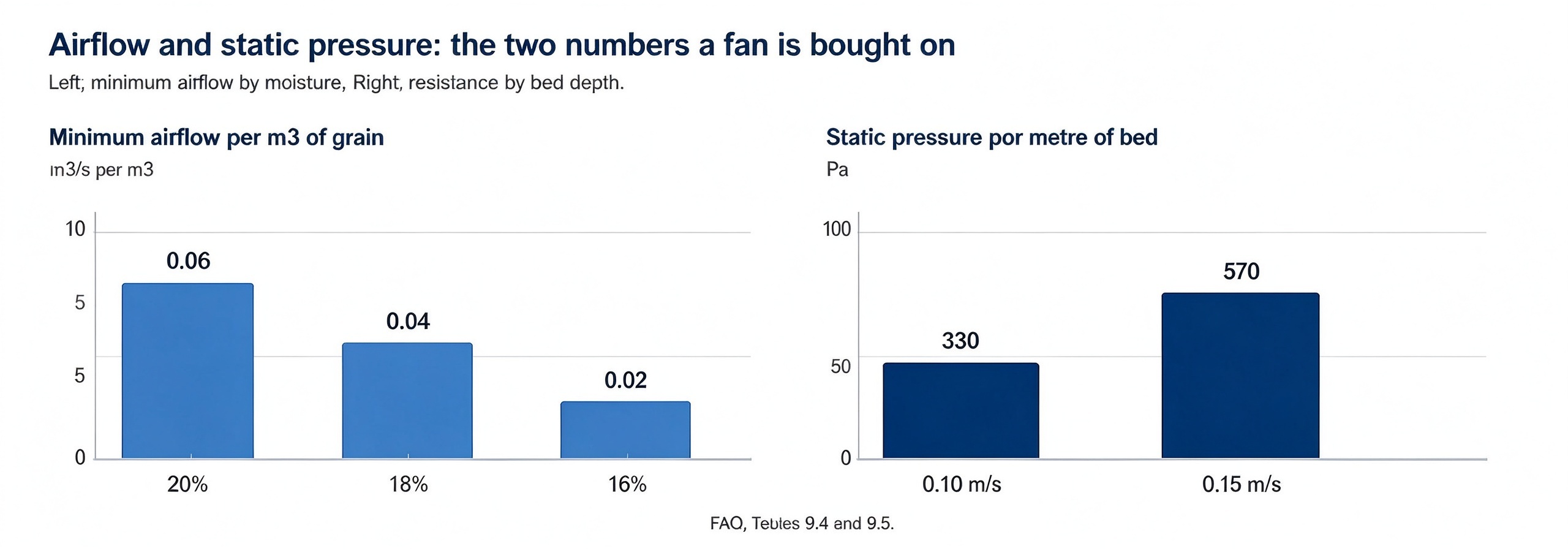
Fan selection is arithmetic, and it starts from the water in the grain rather than the tonnage. Minimum airflow for wheat is set by moisture: 0.06 m³/s per m³ of grain at 20%, 0.04 at 18% and 0.02 at 16% (FAO, Table 9.4). Resistance then rises with depth: at 0.10 m/s a metre of wheat costs 330 Pa, and at 0.15 m/s it costs 570 Pa (FAO, Table 9.5).
The two tables explain a sizing error that appears in most small projects.A fan matched to a maize duty does not transfer to wheat.
-
In the FAO worked example, a 2.2 kW fan delivers 4,850 m³/h against 480 Pa for a 10 t maize batch at 1.5 m depth over 60 hours; on wheat the resistance at the 1.5 m layer used in that example rises to about 860 Pa, and the layer has to come down to about 1 m or the fan has to be a higher-pressure unit.
-
Grain cleanliness moves the same figure: chaff and fines block the spaces between kernels, resistance climbs, and drying slows without any change to the dryer setting.
Heat per Tonne and the Wheat Drying Cost Basis
Cost per tonne is driven by kilograms of water removed, not by tonnes of grain handled.
-
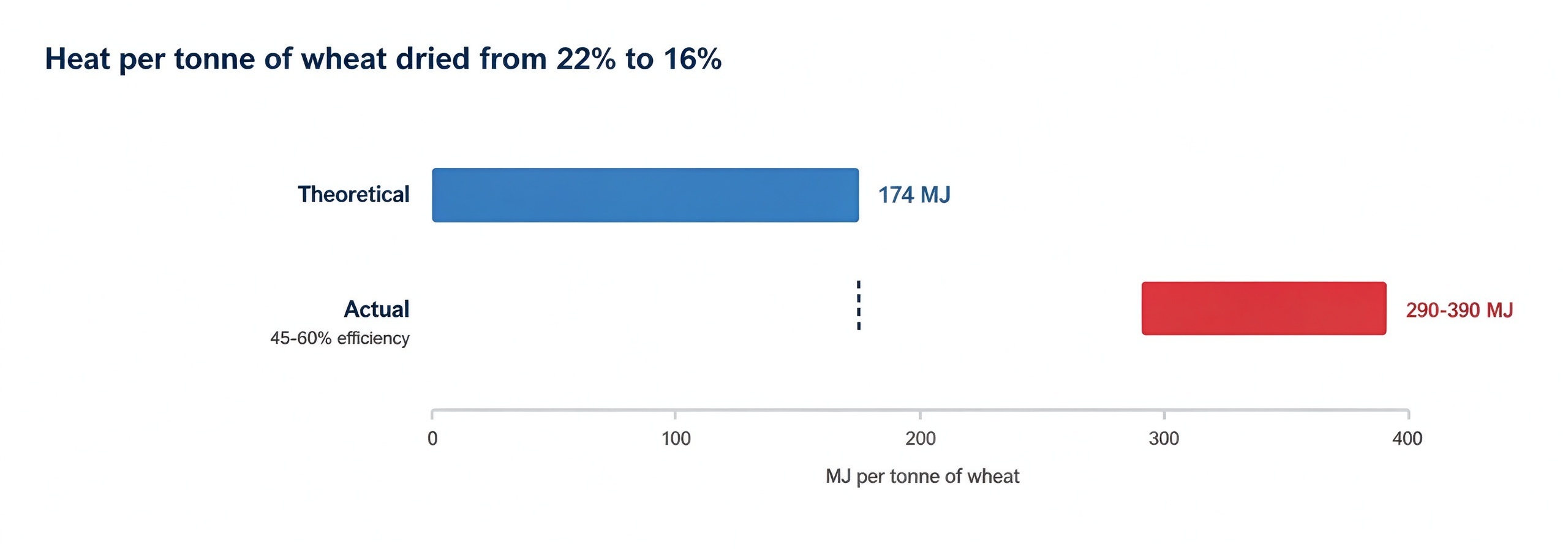
One tonne dried from 22% to 16% gives up 71 kg of water (FAO, Table 9.2), which is the quantity a fuel budget has to be built on. The theoretical heat is about 174 MJ, being 71 kg multiplied by roughly 2,450 kJ per kg of vaporisation at ambient temperature.
-
Real consumption is higher, because exhaust air leaves warm and partly saturated. At an assumed dryer thermal efficiency of 45 to 60%, a figure that has to be confirmed against the manufacturer’s fuel test on the buyer’s own grain, the requirement lands between 290 and 390 MJ per tonne of wheat dried through that range. Fuel price is local, so the useful step is to convert that MJ figure with the delivered price per litre or per cubic metre rather than to compare quotes in different currencies. Electrical demand is separate and follows the fan.
One basis has to be fixed before any of this is compared. A cost quoted per tonne of wet grain and a cost quoted per tonne of dried grain differ by the water removed, 7% in the case above, and two quotations can look 7% apart while describing the same plant. The same discipline applies at a larger scale when capacity is chosen, as set out in the flour mill plant capacity selection guide.
Send the intake moisture band, the target moisture and the local heat source, and the airflow, fuel demand and holding capacity for that case can be calculated. The engineering team quotes against those three inputs rather than against a tonnage figure alone. Click the button below to request a wheat drying machine specification for the site.

What a Wheat Drying Section Adds to a Flour Mill Plant
A wheat drying machine is not bought as a standalone unit. It brings a wet bin, a dry bin, an air system, a dust collector and its own connected load, and it changes the layout of the intake end of the plant, which is why a wheat drying machine for a flour mill is quoted with its bins rather than on its own. Sizing the section therefore means sizing those parts together with the mill behind it.
Flour Mill Plant Capacity Bands and Where Drying Fits
Flour lines are quoted in three bands: 5 to 30 t/d for a small plant, 30 to 80 t/d for a medium one, and 80 to 500 t/d for a large one. The drying requirement does not scale with the band, because it depends on how far above the storage threshold the local harvest arrives. A 15 t/d plant in a wet district can need a larger dryer than a 100 t/d plant that buys dry grain, and quoting by tonnage alone is how that difference gets lost.
Plant Footprint and Connected Power of a Flour Mill
The building and the power supply are decided by the milling line first, and the drying section is added to both. As reference, the wheat lines we build in the 80 to 500 t/d range carry the following connected load and building envelope; the dryer, its bins and its air system sit in addition to these figures and are quoted from the site conditions.
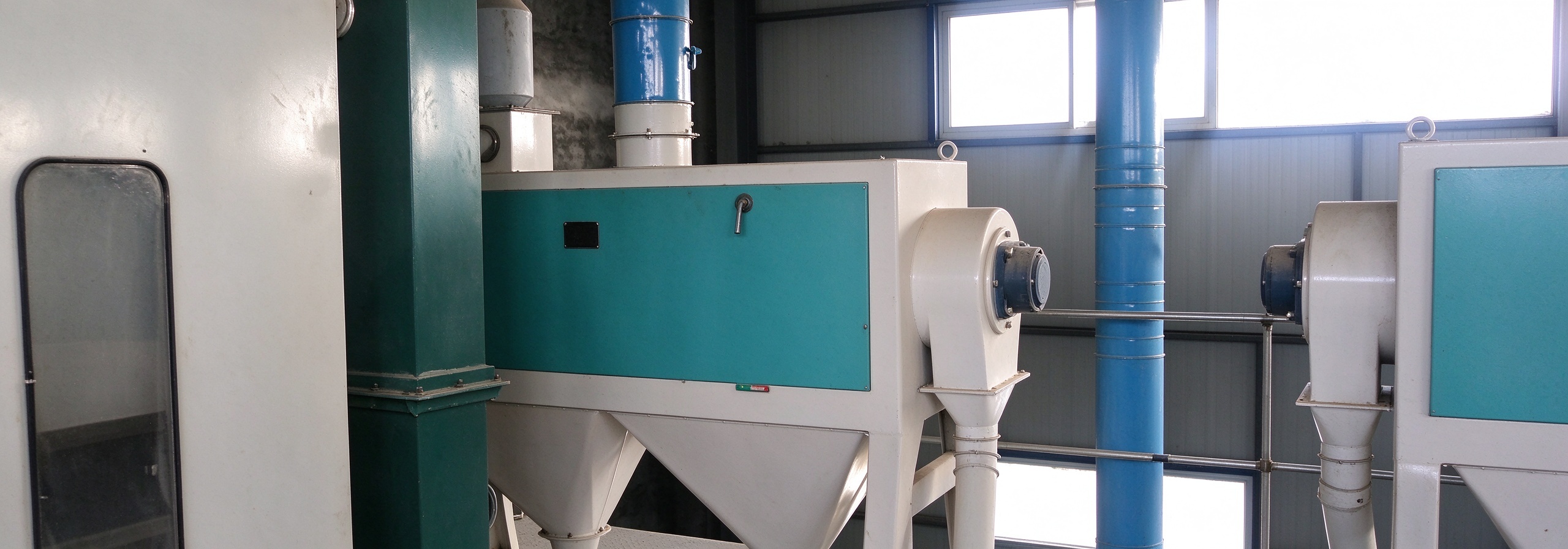
The milling section the dryer feeds.
| Line capacity | Connected power | Building envelope (L×W×H) |
|---|---|---|
| 80 t/d | 236 kW | 30 × 8 × 10 m |
| 100 t/d | 370 kW | 30 × 10 × 13 m |
| 150 t/d | 580 kW | 42 × 10 × 18 m |
| 200 t/d | 710 kW | 42 × 10 × 21.5 m |
| 300 t/d | 960 kW | 50 × 15 × 25 m |
| 500 t/d | 1,520 kW | 60 × 18 × 28 m |
Interface with Grain Cleaning, Silos and the Mill
Three interfaces decide whether the section runs at the rate it was sized for. At the inlet, the cleaning house has to deliver grain at a steady rate, because a dryer fed in batches dries unevenly and records a moisture figure that does not describe the whole lot. At the outlet, holding capacity in storage silos sets how long the mill can run while the dryer is idle. Between the two, the air system has to be sized for the depth actually used rather than for the depth in the brochure, for the reason set out above.
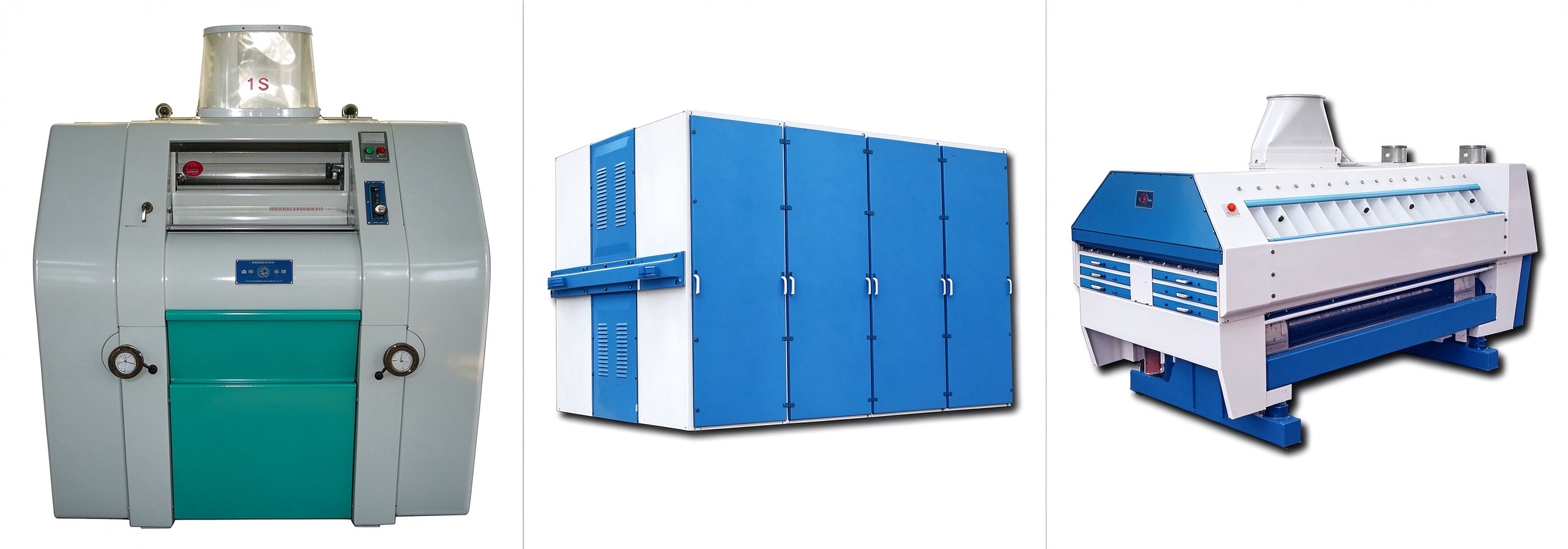
Roller mill, plansifter and purifier, downstream of drying.
Cooling Section and Dust Control
Two items are commonly left out of a drying quotation. The first is an ambient cooling section sized for local humidity: without it, warm grain goes into the bin and re-wets on the surface as it cools. The second is dust collection rated for the fines a dryer generates, because hot-air grain drying raises a dust explosion hazard that a cleaning house alone does not cover.
ABC Machinery: Factory, Flour Milling Line and Engineering Service
ABC Machinery builds the whole line, not only the dryer. The drying section is designed and fabricated in the same works as the cleaning house, the roller mills, the plansifters, the purifiers and the packing equipment, which is why the interfaces described above arrive as one set of drawings rather than as three suppliers arguing over a battery limit.
The Factory Behind the Flour Milling Line
The company began as Henan Kingman Mechanical & Electrical Complete Plant Co., Ltd in 1992, and became ABC Machinery (Anyang Best Complete Machinery Engineering Co., Ltd) in 2014, when KMEC and GEMCO formed a joint venture. More than three decades in grain processing machinery sit behind the current range. Manufacturing is carried out in our own plant at Anyang, Henan, with a dedicated assembly area, a finished product area, and a quality inspection and packaging area.
Flour Milling Line Range and Grain Types
Turnkey flour projects run from 10 to 500 t/d, across wheat, maize, rice, cassava, sorghum and bean. Equipment has been exported to more than 30 countries and regions, with the main markets in Africa, South America, South-east Asia, South Asia, the Middle East and Europe. Installed lines at 10 to 160 t/d are listed under flour mill projects, and the product range is set out under flour mills.
Engineering Service Around the Wheat Drying Machine
The service around the machine is what a drying section actually depends on, because a dryer is commissioned against a harvest that will not wait. ABC Machinery provides requirement consultancy, solution design, equipment manufacturing, on-site installation, staff training, repair and maintenance, and business extension advice; the turnkey scope runs from evaluation and process engineering through procurement, installation and commissioning to after-sales service and financing. Enquiries are answered in English, Spanish, Russian, French and Arabic, with a reply within one business day, and lines in operation are supported online when a fault appears during the season.
A wheat drying machine covers a short stage in a wheat line and an expensive one to get wrong, because a grain temperature set too high shows up months later as extraction loss rather than as a machine fault. The four sections above — where drying sits in the process, which type and which limits apply, what the section adds to the plant, and what to check on the supplier — read as one acceptance list against which a quotation can be compared.
- Does a flour mill need a wheat drying machine if grain arrives at 12.5%?
- No. At 12.5% the grain is already below the 13.5% storage equilibrium and close to milling moisture, so the requirement is conditioning, not drying. A dryer is justified only where a meaningful share of intake arrives above roughly 15%.
- What is the maximum drying temperature for milling wheat?
- 60 °C grain temperature is the ceiling most often quoted for food wheat, with seed wheat held lower. The safe figure depends on variety and end use, so it should be confirmed against a sample test rather than taken from a brochure.
- How much water is removed per tonne of wheat?
- One tonne dried from 22% to 16% gives up 71 kg of water, and the same calculation applies at other ranges using the FAO wet-basis weight formula. Fuel and fan power both scale with that mass of water, not with the tonnage passing through.
- Can one dryer handle both seed wheat and milling wheat?
- Usually not at the same setting. Seed wheat tolerates a lower grain temperature and is dried one to two points further, so a shared unit has to run two programmes and be cleaned between them. Where seed is a small share of volume, a batch dryer is the practical compromise.
- What moisture content should wheat be at before milling?
- 14 to 16% at the mill inlet, reached by conditioning rather than by drying, with hard wheat at the upper part of that band and a rest period measured in hours. Drying only brings wet intake down to the storage threshold of 13.5%; the mill then adds water back.
- What decides the price of a wheat drying machine?
- Four things move a wheat drying machine price far more than tonnage: the moisture band it has to remove, the heat source and its fuel system, the dust collection rated for the fines it generates, and the wet and dry buffer bins on either side. Two quotations for the same tonnage can describe different machines.
- Is it cheaper to dry wet wheat or to buy dry wheat?
- That is a local price comparison, and it changes with the discount for wet grain against the delivered fuel price. The comparison needs three figures: the moisture discount at the point of purchase, megajoules per tonne from the calculation above, and the local fuel price. Without the discount figure the comparison cannot be made.
- Single Flour Milling Machine
- Small Scale Flour Mill
- Large Scale Flour Mill
- Storage Silos
- Pneumatic Grain Conveyor

- Small Maize / Corn Flour Mill Machinery Design and Layout
- How to Choose a Reliable Small Wheat Grinding Machine Sale?
- How to Set Up Your Own Mini Wheat Flour Milling Plants at Home?
- Soy Protein Isolation Production Line Cost
- Cost of Setting Up A Soybean Isolate Protein Plant
- Characteristics And Application of Soy Protein Isolate
- How to Maintain Your Own Home Flour Mill Equipment
- How to Make Maize Flour at Home