
Square Plansifter Selection Guide
The square plansifter is the core screening equipment for wheat flour production, and an essential unit in wheat flour mills. It operates in close coordination with the complete wheat flour production process. Selection should not be based merely on appearance or the number of layers; decisions need to be made considering target capacity, effective screening area, material balance, product grades, mill site conditions and maintenance requirements.

Functions of Square Plansifter in Flour Production Line
Installed downstream of the milling section, the square plansifter performs planar rotary motion to classify and separate milled mixtures by particle size and material properties. Separated materials are sent to finished product, purifying, and regrinding return processes respectively, connecting with purifiers, return conveying, flour blending and packaging systems. It undertakes four main tasks in the wheat flour production line:
-
Flour classification: Separate endosperm powder meeting particle size requirements (generally 90~100 mesh). Specific indicators shall be subject to product standards, sieve specifications and sifting test results.
-
Intermediate material diversion: Retain wheat middlings, coarse endosperm and red dog flour, which return to the corresponding break roll / reduction roll. Typical particle size range of wheat middlings is 40~70 mesh; the actual range depends on raw materials and mill flow design.
-
By-product separation: Separate by-products such as coarse bran and fine bran. Coarse bran can be materials retained above 36-mesh sieve or coarser fractions; specific classification limits are determined by sieve specifications and by-product requirements.
-
Finished product inspection sieve: An inspection sieve installed before finished product packaging to prevent coarse particles, flour lumps, bran specks and other impurities from entering final products.
When used in the finishing section, the square plansifter serves as a dedicated "finished product inspection sieve". Its core function is to reduce the risk of coarse particles, flour lumps, bran specks and foreign matter getting into packaged products. The term "inspection sieve" refers to the specific screening process instead of an evaluation of the equipment’s sifting performance.
For equipment with the same number of layers, the unit screen load can fluctuate by 20%~40%. If you need material balance calculation and square plansifter selection verification for your wheat milling project, submit your capacity, raw material parameters and workshop conditions to ABC Machinery via the button below. Our engineers can quickly provide matching mill flow plans and equipment configuration references.

Key Parameters for Square Plansifter Selection
Screening Area: Do Not Judge Solely by Daily Capacity
Screening area is one of the core selection indicators for square plansifters in wheat flour production. Insufficient screening area may lead to excessive screen load, incomplete classification and increased return flow. Excessively large area will raise equipment investment, floor space and maintenance workload for flour mills.
Below are reference data for the FSFG series published by ABC Machinery:
|
Model |
Number of Sieve Compartments |
Sieve Body Dimension |
Reference Screening Area |
Reference Power |
Reference Weight |
|---|---|---|---|---|---|
|
FSFG4×24C |
4 |
640×640 mm |
21.0–38.2 m² |
4 kW |
2,750 kg |
|
FSFG6×24C |
6 |
640×640 mm |
31.6–57.3 m² |
5.5 kW |
3,700 kg |
|
FSFG8×24C |
8 |
640×640 mm |
42.1–76.4 m² |
7.5 kW |
4,700 kg |
|
FSFG4×24H |
4 |
740×740 mm |
30.4–53.4 m² |
5.5 kW |
3,500 kg |
|
FSFG6×24H |
6 |
740×740 mm |
45.6–80.1 m² |
7.5 kW |
4,900 kg |
|
FSFG8×24H |
8 |
740×740 mm |
60.8–106.8 m² |
11 kW |
6,600 kg |
|
FSFG10×24H |
10 |
740×740 mm |
95–115 m² |
15 kW |
7,300 kg |
The above data is only for preliminary selection reference for wheat flour mills. The actual effective area depends on sieve combination, screen layer utilization rate, material load, target flour types and mill flow circulation. The maximum listed area cannot be directly converted into a fixed daily capacity.
Number of Sieve Compartments and Sieve Layer Configuration
The published FSFG models cover 4, 6, 8 and 10 sieve compartments. When purchasing wheat flour production equipment and comparing prices, do not judge quality merely by the quantity of sieve compartments. You must sort out the complete mill flow logic of the plant first to accurately control costs of the flour mill and select suitable production equipment.
|
Items to Confirm |
Expected Output Data |
|---|---|
|
Flour products and grades |
Number of finished product streams, target flow rate of each stream |
|
Intermediate material return |
Number of return streams, return flow per stream, return destination |
|
Sieve compartment interface |
Quantity of inlet, outlet and return ports of each sifter |
|
Sieve cloth and sieve layers |
Sieve specification of each layer, effective area and standby quantity |
Different specifications correspond to different prices of wheat flour processing equipment and match different production processes and workshop conditions. Before installation of flour processing equipment, additionally check the following:
-
Load-bearing capacity of platform or floor slab.
-
Vertical space for feeding, discharging and return pipelines
-
Maintenance clearance for sieve compartment pulling-out, screen replacement and cleaning
-
Hoisting, maintenance and replacement route for large components
-
Dust removal connection, electrical control position and dust-proof sealing conditions
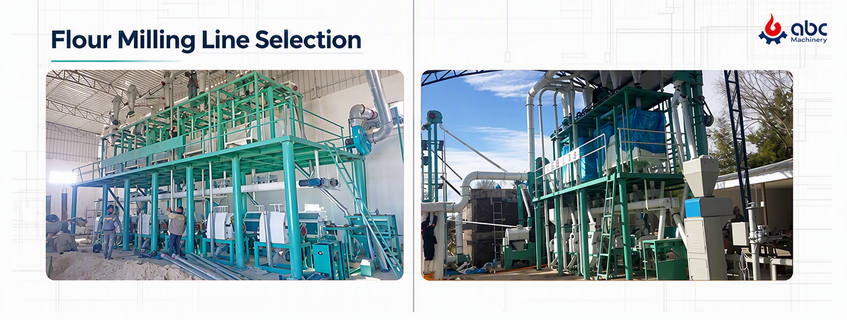
Wheat Flour Mill Production Line Project Installation Site
- Do Not Confuse Rotary Sieve with Square Plansifter
Both square plansifters and rotary sieves belong to screening equipment for wheat flour production, yet they differ greatly in structure, process application and applicable positions in the flour production line.
|
Comparison Item |
Square Plansifter |
Rotary Sieve |
|---|---|---|
|
Typical Structure |
Multi-layer sieve compartments, cabinet-type sieve body |
Rotary sieve cylinder or rotary screening structure, subject to specific models |
|
Common Tasks |
Multi-stream classification, intermediate material diversion, finished product inspection sieve |
Auxiliary sifting, inspection sieve or screening of specific materials |
|
Selection Focus |
Effective screening area, number of sieve compartments, mill flow interfaces |
Sieve cylinder / screen structure, processing task and discharge mode |
|
Direct Substitution |
Not possible by name only |
Verify according to process location and screening tasks |
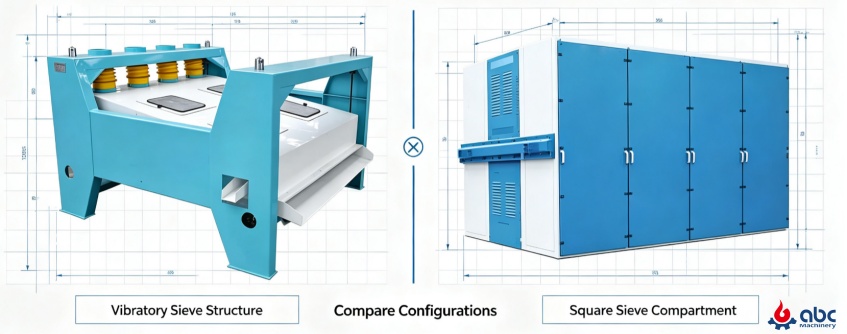
Square Plansifter VS Vibratory Sieve Technical Comparison Diagram
Rotary sieves cannot directly replace square plansifters in flour production lines. The final selection shall be determined based on material route and screening requirements.
How ABC Machinery Delivers Square Plansifter Solutions
ABC Machinery has long been engaged in wheat flour production process R&D and customized flour processing equipment. We serve clients across Southeast Asia, Africa, Central Asia, Eastern Europe, Latin America and other regions, accumulating abundant project implementation experience under diverse local wheat raw material conditions. Wheat quality, power supply standards and workshop codes vary from country to country. For overseas projects, ABC Machinery adjusts wheat flour production processes and equipment configurations to suit local working conditions and meet clients’ budget requirements.
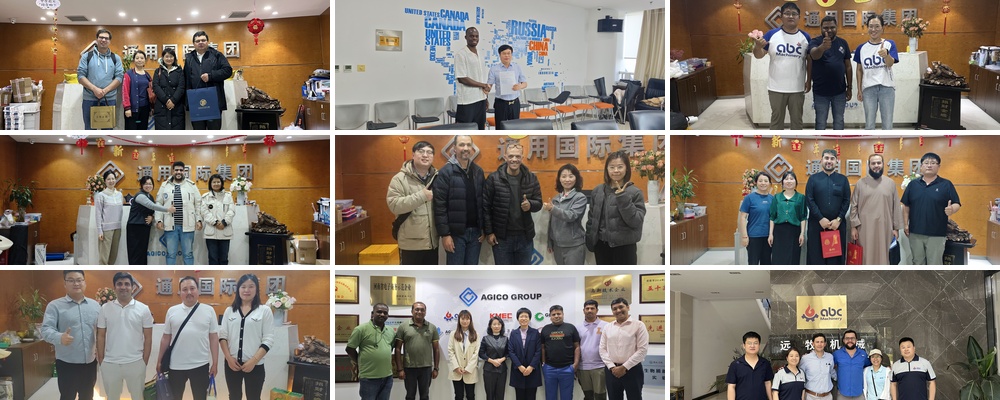
International Customers Visiting Flour Machinery Factory
Square plansifters shall not be purchased separately from the whole flour production line. After submitting project location, target capacity, raw material type, product grades, workshop dimensions and existing equipment list, ABC Machinery engineers will evaluate equipment configuration, engineering boundary and quotation more accurately within 24 hours.
- Single Flour Milling Machine
- Small Scale Flour Mill
- Large Scale Flour Mill
- Storage Silos
- Pneumatic Grain Conveyor
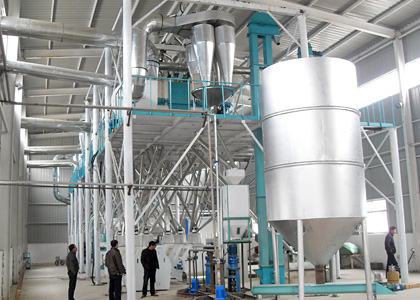


- Small Maize / Corn Flour Mill Machinery Design and Layout
- How to Choose a Reliable Small Wheat Grinding Machine Sale?
- How to Set Up Your Own Mini Wheat Flour Milling Plants at Home?
- Soy Protein Isolation Production Line Cost
- Cost of Setting Up A Soybean Isolate Protein Plant
- Characteristics And Application of Soy Protein Isolate
- How to Maintain Your Own Home Flour Mill Equipment
- How to Make Maize Flour at Home